Chocolate Coffee Cookies Overview and Product Characteristics in Industrial Manufacturing Context
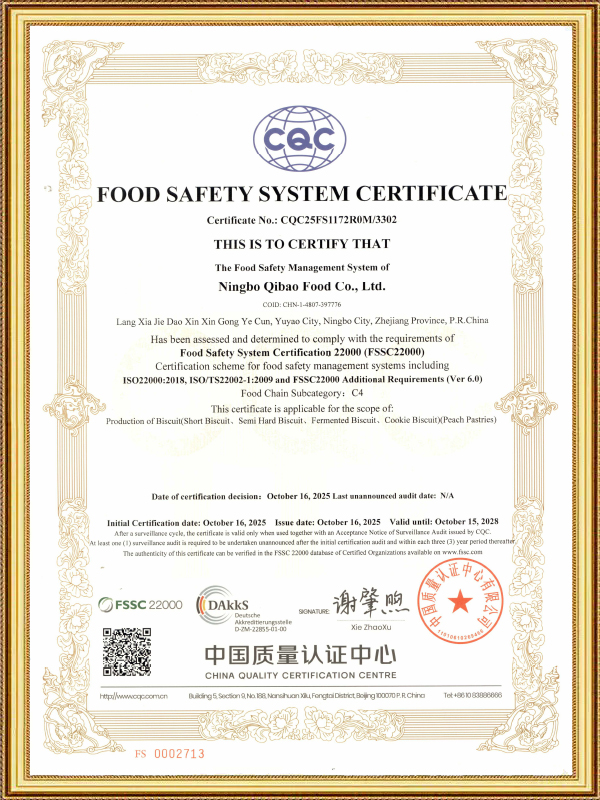
Chocolate Coffee Cookies are a distinctive category of baked products that combine the deep, rich taste of cocoa with the aromatic intensity of coffee. In an industrial manufacturing context, we approach Chocolate Coffee Cookies not only as a finished consumer product but also as a carefully engineered formulation that balances flavor, texture, appearance, and shelf stability. Within the operations of Ningbo Qibao Food Co., Ltd., Chocolate Coffee Cookies are developed with a clear focus on consistency and repeatability across large production volumes, ensuring that each unit maintains a uniform sensory profile. The sensory characteristics of Chocolate Coffee Cookies are defined by several interrelated factors. Flavor complexity arises from the interaction between cocoa solids and coffee compounds, producing a layered taste that includes bitterness, sweetness, and subtle roasted notes. Aroma is equally important, as volatile compounds released during baking contribute to a recognizable and appealing scent profile. Texture is engineered to achieve a balance between crispness and structural integrity, often influenced by ingredient ratios and baking conditions. Appearance, including color uniformity and surface finish, also contributes to consumer perception and product acceptance. In the production environment of Ningbo Qibao Food Co., Ltd., Chocolate Coffee Cookies are treated as a standardized product category supported by controlled processes and technical expertise. The company integrates ingredient formulation, process control, and quality monitoring to maintain stability in sensory attributes across batches. The combination of cocoa and coffee requires precise calibration to avoid dominance of either component while preserving a harmonious flavor balance. Industrial-scale consistency is achieved through systematic control of mixing, forming, baking, and cooling parameters, allowing Chocolate Coffee Cookies to meet defined product specifications reliably.
| Parameter Category |
Component Type |
Typical Range |
Functional Role |
Quality Consideration |
| Base Structure |
Wheat Flour |
45%–60% |
Provides structure and texture |
Protein content consistency |
| Flavor Core |
Cocoa Powder |
5%–15% |
Chocolate flavor and color |
Fat content and alkalinity |
| Flavor Core |
Coffee Powder/Extract |
1%–5% |
Aroma and bitterness |
Solubility and freshness |
| Sweetening Agent |
Sugar |
20%–35% |
Sweetness and browning |
Granule size and purity |
| Fat Component |
Butter/Oil |
10%–25% |
Texture and mouthfeel |
Melting point and stability |
The formulation of Chocolate Coffee Cookies relies on a structured combination of ingredients, each contributing specific functional properties to the final product. In industrial production environments such as Ningbo Qibao Food Co., Ltd., ingredient selection is guided by quality standards, functional performance, and compatibility within large-scale processing systems. Core ingredients typically include wheat flour, cocoa powder, coffee derivatives, sugar, fats, leavening agents, emulsifiers, and optional flavor enhancers. Wheat flour serves as the structural base, forming gluten networks that provide strength and cohesion to the dough. Cocoa powder contributes not only chocolate flavor but also color and minor textural influence due to its fat and fiber content. Coffee ingredients, whether in powder or extract form, introduce aromatic compounds that define the distinctive identity of Chocolate Coffee Cookies. Sugar plays multiple roles, including sweetness, moisture retention, and participation in browning reactions during baking. Fats improve mouthfeel, reduce toughness, and assist in creating a tender crumb structure.
Within Ningbo Qibao Food Co., Ltd., ingredient handling is managed through controlled procurement and storage systems. Each raw material is evaluated for consistency, purity, and compliance with internal specifications before being introduced into production. Functional additives such as emulsifiers assist in stabilizing mixtures and improving uniform distribution of ingredients, while leavening agents regulate expansion and texture development during baking. The interplay between these components must be carefully balanced to ensure that Chocolate Coffee Cookies exhibit consistent performance during mixing, forming, and thermal processing. Industrial formulation also considers variability in raw materials. Slight differences in moisture content, fat composition, or particle size can affect dough behavior and final product quality. At Ningbo Qibao Food Co., Ltd., formulation adjustments are made based on measured parameters to maintain stability. This systematic approach allows Chocolate Coffee Cookies to achieve predictable outcomes across production batches while preserving desired sensory and structural characteristics.
Dough mixing represents a critical stage in the production of Chocolate Coffee Cookies, as it directly influences texture, uniformity, and processing behavior. In industrial environments such as Ningbo Qibao Food Co., Ltd., mixing operations are conducted using controlled equipment that ensures consistent energy input, timing, and ingredient incorporation. The objective is to achieve a homogeneous dough in which all ingredients are evenly distributed without overdevelopment or under-mixing. During the mixing process, dry ingredients such as flour, cocoa powder, and coffee components are combined with wet ingredients including fats, sugar solutions, and liquid additives. The sequence of addition and the mixing intensity are carefully managed to control gluten formation and prevent structural inconsistencies. Overmixing can lead to excessive gluten development, resulting in a tougher texture, while insufficient mixing may produce uneven distribution of cocoa and coffee particles, affecting both flavor and appearance of Chocolate Coffee Cookies.
At Ningbo Qibao Food Co., Ltd., process control systems are implemented to monitor mixing time, speed, and temperature. These parameters are adjusted based on formulation requirements and batch size. Temperature control is particularly important, as it affects fat behavior and dough consistency. Maintaining an optimal temperature range ensures that fats remain in a workable state, facilitating uniform blending and preventing phase separation. We also consider the rheological properties of the dough, which influence its flow behavior during forming and shaping. Properly mixed dough should exhibit consistent viscosity and elasticity, allowing it to pass smoothly through forming equipment. Inconsistent mixing can lead to variations in dough handling, resulting in defects in Chocolate Coffee Cookies such as irregular shapes or uneven baking. Through standardized procedures and experienced technical oversight, Ningbo Qibao Food Co., Ltd. maintains strict control over the mixing stage, ensuring that downstream processes operate efficiently and produce high-quality outcomes.
Forming is the stage in Chocolate Coffee Cookies production where mixed dough is shaped into uniform pieces prior to baking. In industrial settings such as Ningbo Qibao Food Co., Ltd., forming processes are designed to achieve high precision, repeatability, and efficiency. Common forming methods include rotary molding, extrusion, and wire cutting, each selected based on product design and desired texture. Rotary molding is often used for cookies with intricate patterns or consistent thickness. In this method, dough is pressed into engraved molds that impart shape and surface design. Extrusion techniques involve forcing dough through shaped openings, creating continuous strands that are later cut into uniform segments. Wire cutting allows for portioning dough into individual units while maintaining internal texture characteristics. The selection of forming method depends on the formulation of Chocolate Coffee Cookies and the intended product appearance.
At Ningbo Qibao Food Co., Ltd., forming equipment is integrated into continuous production lines, allowing for synchronized operation with mixing and baking stages. This integration minimizes manual handling and reduces variability. Dough consistency plays a significant role in forming performance; if the dough is too soft or too stiff, it may not maintain shape during processing. Therefore, parameters established during mixing directly influence forming efficiency. Standardization of shape and weight is essential for uniform baking and packaging. Variations in size can result in inconsistent heat transfer during baking, leading to differences in texture and moisture content. In large-scale production, Chocolate Coffee Cookies must meet strict tolerances to ensure uniformity across batches. Ningbo Qibao Food Co., Ltd. applies calibration and monitoring systems to maintain these tolerances, allowing Chocolate Coffee Cookies to exhibit consistent physical characteristics such as diameter, thickness, and weight distribution.
The baking stage transforms raw dough into finished Chocolate Coffee Cookies through a series of thermal and chemical reactions. Within Ningbo Qibao Food Co., Ltd., baking operations are conducted using industrial ovens equipped with precise temperature and airflow control systems. These systems allow us to regulate heat distribution and maintain consistent baking conditions across production batches. During baking, several key reactions occur. Moisture evaporation reduces the water content of the dough, contributing to texture development and shelf stability. Maillard reactions between proteins and sugars produce browning and flavor compounds that enhance the overall sensory profile. Caramelization of sugars further contributes to color and taste complexity. The combination of cocoa and coffee compounds undergoes transformation under heat, intensifying the characteristic aroma of Chocolate Coffee Cookies.
Temperature profiling within the oven is carefully managed to ensure even heat exposure. Variations in temperature can lead to uneven baking, resulting in discrepancies in texture and color. At Ningbo Qibao Food Co., Ltd., baking parameters such as temperature, time, and conveyor speed are optimized based on product specifications. Continuous monitoring allows adjustments to be made in real time to maintain consistency. Airflow and humidity within the baking chamber also influence product outcomes. Controlled airflow ensures uniform heat transfer, while humidity levels affect moisture evaporation rates. Proper balance of these factors helps achieve the desired crispness and structural integrity of Chocolate Coffee Cookies. The baking stage is therefore not only a thermal process but also a highly controlled operation that integrates multiple variables to produce a stable and high-quality product.
| Process Stage |
Key Parameter |
Operating Range |
Equipment Used |
Control Objective |
| Mixing |
Mixing Speed |
20–80 RPM |
Industrial mixer |
Uniform dough consistency |
| Mixing |
Mixing Time |
5–15 minutes |
Batch mixer |
Proper ingredient dispersion |
| Forming |
Dough Temperature |
20–30°C |
Forming machine |
Maintain dough plasticity |
| Baking |
Oven Temperature |
160–220°C |
Tunnel oven |
Ensure proper browning |
| Cooling & Packaging |
Cooling Time |
10–30 minutes |
Cooling conveyor |
Moisture stabilization |
After baking, Chocolate Coffee Cookies undergo a cooling phase that stabilizes their structure and prepares them for packaging. In industrial environments such as Ningbo Qibao Food Co., Ltd., cooling systems are designed to gradually reduce product temperature while maintaining product integrity. Rapid or uneven cooling can lead to condensation, which negatively affects texture and shelf life. Cooling conveyors are commonly used to transport cookies through controlled environments where ambient temperature and airflow are regulated. During this phase, residual heat dissipates, and internal moisture redistributes within the product. Moisture equilibration is essential for achieving consistent texture, as it influences crispness and resistance to breakage. Chocolate Coffee Cookies must reach a stable temperature before packaging to prevent moisture accumulation inside packaging materials.
At Ningbo Qibao Food Co., Ltd., cooling processes are integrated into the production line to ensure seamless transition from baking to packaging. Monitoring systems track temperature and environmental conditions to maintain optimal cooling rates. Structural stabilization occurs as fats solidify and internal components settle, resulting in a product that maintains its shape during handling and transportation. This stage also plays a role in preserving product quality over time. Properly cooled Chocolate Coffee Cookies exhibit reduced risk of microbial growth and improved shelf stability. By controlling cooling parameters, we ensure that each batch meets defined quality standards before entering the packaging phase. The consistency achieved during cooling contributes to the overall reliability of the final product delivered to consumers.

 English
 中文简体
中文简体 Español
 عربى
عربى